




Every millisecond of delay during checkout is money slipping away. Nearly half of online shoppers abandon carts when pages take longer than two seconds to load; a direct hit to revenue and customer trust. The challenge for growing digital businesses isn’t just speed; it’s scaling infrastructure fast enough to match demand without scaling cost, complexity, or risk.
At Aweb Digital, we’ve seen how transformational the right hosting model can be. Businesses adopting managed web hosting scaling are reducing hosting costs by 50%+, cutting DevOps workload by 70%, and converting peak traffic into predictable growth, not performance failures.
Understanding Managed Hosting Scalability: The Foundation for Growth
Scalability isn’t just a technical milestone, it’s now become a growth enabler. With managed web hosting scaling, your site remains fast and stable during traffic surges, product launches, and expanding global demand.
No slowdowns. No scrambling engineers. No lost revenue.
The difference from unmanaged hosting is strategic:
- Automated resource scaling
- Continuous performance optimization
- 24/7 proactive monitoring and support
Infrastructure runs at its best, so your team can focus on innovation instead of firefighting.
Market adoption reflects this shift: VPS usage growth from 2024 to 2025 shows that scalability is now a competitive requirement. SMEs adopting scalable hosting are reducing downtime risks, controlling operational costs, and eliminating the need for heavy in-house DevOps investments.
If you’re experiencing performance drops during peak activity or hitting plan limitations, scalable hosting doesn’t just become an upgrade, but rather a path to sustainable expansion.
Vertical Scaling vs Horizontal Scaling: Choosing the Right Fit
Let’s cut through the technical jargon and talk about what scalability actually means for your business. At its core, managed cloud infrastructure scalability is your ability to handle traffic growth, seasonal spikes, and data expansion without watching your site slow to a crawl or your team scrambling to keep servers running. It’s the difference between thriving during your busiest season and losing customers to timeout errors.
What separates managed VPS hosting from unmanaged solutions is it’s business value. With managed hosting, you get 24/7 expert support, automated provisioning, and proactive monitoring that catches problems before your customers notice them.
We’re talking about reducing your operational burden so you can focus on growth, not infrastructure firefighting.
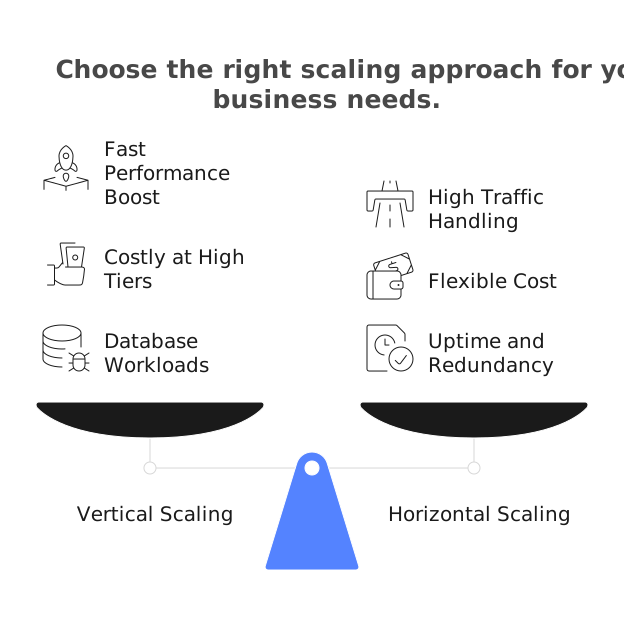
Vertical Scaling vs Horizontal Scaling: Which Approach Fits Your Business?
There are two primary models of scaling:
Vertical Scaling
Enhance the power of a single server — more CPU, RAM, and storage.
Ideal for:
- Fast upgrades without architecture changes
- Database-heavy workloads needing stronger single-node performance
Horizontal Scaling
Add multiple servers and distribute the load.
Essential for:
- High-traffic eCommerce and SaaS platforms
- Redundancy and uptime during demand surges
- Zero-tolerance environments for single points of failure
Most growth-ready businesses eventually use a hybrid model, that’s vertical for efficiency, horizontal for resilience.
The cost implications matter too. Vertical scaling can get expensive as you reach higher resource tiers, and there’s a physical limit to how much you can upgrade a single server. Horizontal scaling offers more flexibility and can be more cost-effective at scale, but it requires more sophisticated load balancing and application architecture.
The good news?
With managed hosting providers, you don’t need to become an infrastructure expert to make these decisions work. They handle the technical complexity of both approaches. According to UpCloud’s guide on web hosting at scale, the key is matching your scaling approach to your application architecture and growth patterns.

Suggested reading:
Managed Cloud Hosting Guide for SMEs: Essentials and Advantages To Know
Cost Management and ROI: Scaling Without Cost Spikes
Growth should increase revenue, not your hosting bill.
Yet many businesses fear that more traffic means proportionally higher infrastructure spend. With managed web hosting scaling, the opposite becomes true: you can scale performance without scaling cost.
The strategy starts with choosing the right pricing model:
- Fixed Plans – predictable budgeting, best for consistently high traffic
- Pay-as-you-go – cost-efficient for variable demand, requires monitoring
- Tiered Pricing – supports steady growth, but watch thresholds to avoid sudden jumps
But hosting fees are only one piece of your TCO (Total Cost of Ownership).
When comparing managed vs unmanaged infrastructure, factor in:
- DevOps workload
- Downtime-related revenue loss
- Performance-linked conversion loss
- Security and compliance risks
Once those are accounted for, scalable managed hosting consistently delivers lower overall cost and higher profit protection.
Real-world example: After moving hundreds of WordPress websites from AWS, WPStaq achieved 50%+ reduction in hosting spend and 70% less DevOps effort, directly redirecting team capacity into revenue-generating work.
Proven cost optimization levers:
- Rightsize infrastructure based on real usage
- Enable advanced caching to cut server load by 30-50%
- Implement CDN delivery to reduce bandwidth and accelerate global load time
- Schedule maintenance outside peak revenue windows
Is Your Website Ready to Scale?
Power your growth with scalable web hosting that expands seamlessly as traffic and demands rise. From sudden surges to long-term growth, enjoy consistent performance, built-in resilience, and expert support, so your website never holds your business back.
Transparent Pricing Models: Avoiding Hidden Costs and Budget Surprises
Now, the hidden costs checklist you need when evaluating providers:
- Bandwidth Overage Fees:
What happens when you exceed your monthly bandwidth allocation? - Backup and Restore Charges:
Are automated backups included, or do they cost extra? - SSL Certificate Costs:
Some providers include SSL, others charge per certificate - Premium Support Tiers:
Is 24/7 support included, or do you pay extra for faster response times? - Migration Assistance Fees:
Will they help you migrate for free, or is there a professional services charge? - DDoS Protection Add-ons:
Is basic DDoS protection included, or is it a paid extra? - Contract Early Termination Penalties:
What if you need to leave before your contract ends?
When evaluating SLAs (Service Level Agreements), ask these questions:
- What’s the guaranteed uptime percentage, and what does it mean in actual downtime?
- What compensation do you get if they breach the SLA?
- Are there exclusions or “scheduled maintenance” windows that don’t count against uptime?
- How quickly do they commit to responding to support tickets?
Migration & Upgrade Strategies: Scaling Without Disruption
Many businesses hesitate to scale because they fear downtime, data loss, or broken customer experiences. Valid concerns, but entirely preventable with a structured approach. Managed web hosting scaling ensures migration becomes a controlled upgrade, not a risky leap.
Clear signals it’s time to move:
- Persistent slow performance even after optimization
- Downtime during peak demand
- Hitting resource limits or storage ceilings
- Outdated infrastructure causing security risk
- Hosting costs rising faster than revenue
A proven phased migration framework:
- Assessment – Inventory infrastructure, integrations, and dependencies
- Planning – Define timelines, rollback checkpoints, and stakeholder communication
- Execution – Staged migration with mirrored environments and low-TTL DNS cutover
- Validation – Performance tests, monitoring setup, and short-term fallback environment
This is how WPStaq successfully migrated hundreds of sites from AWS to a managed platform, cutting hosting costs by 50%+ and reducing DevOps workloads by 70% without disruption.
Migration doesn’t have to break your business; it should prepare it for growth.

Suggested reading:
Why Cloud Compliance and Managed Hosting are Critical for 2025’s Regulatory Demands
Security & Reliability at Scale: Protecting Growth Without Compromise
As infrastructure grows, so does risk. More servers, more data, and more distributed systems expand the attack surface, unless security scales with performance.
The essentials of secure managed web hosting scaling:
- Defense-in-depth: Layered controls across network, application, and data
- Continuous Vulnerability Scanning & Automated Patching: Fix issues before they’re exploited
- Strict Access Governance: Least-privilege policies and MFA for all admin access
- Full Encryption: Data protected at rest and in transit
- 24/7 Monitoring & Threat Detection: Real-time alerts and rapid incident response
Reliability that protects revenue
Uptime directly impacts profit:
- 99.9% uptime = up to 8.76 hours downtime/year
- 99.99% uptime = just 52.56 minutes/year
- For eCommerce, that difference can mean tens of thousands in saved sales or lost ones.
- Kinsta’s 100% uptime achievement in 2025, sets a new expectation for managed hosting performance.
Compliance built for scaling brands
Managed hosting ensures expansion into regulated markets without adding complexity:
Security isn’t overhead, it’s a revenue shield and a growth enabler. Scalable protection maintains customer trust, supports new market entry, and keeps the business online when traffic and opportunity surge.
Is Your Website Protected Against Downtime and Costs?
Keep revenue and trust intact with proactive maintenance. From updates and monitoring to optimisation and fast fixes, we ensure your site stays secure, reliable, and ready to perform.
Emerging Trends Shaping Managed Hosting in 2025
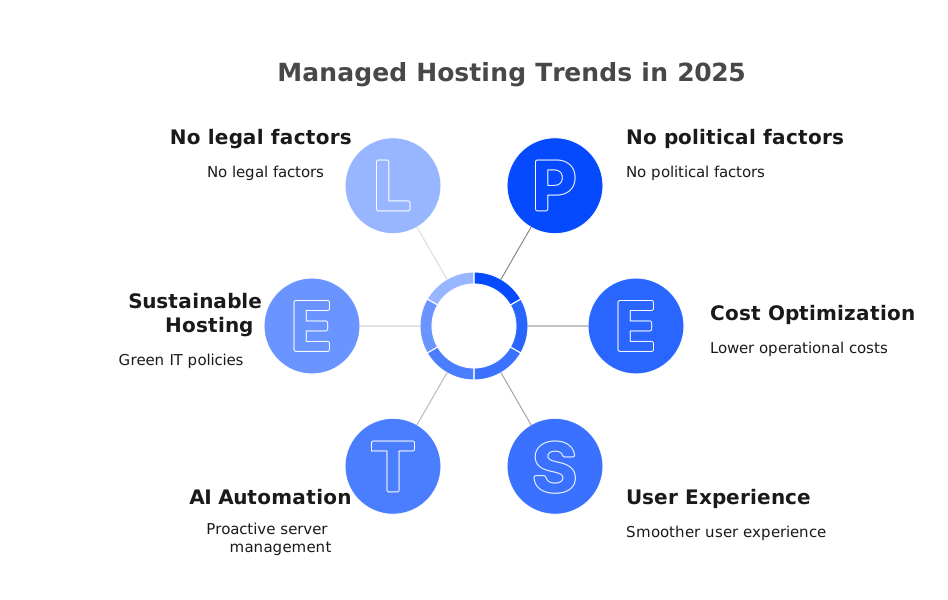
Forward-thinking businesses are already leveraging these trends to scale faster and more efficiently:
AI-Powered Server Management & Support
Over 40% of providers are now using AI to automate performance optimization, predict traffic surges, and accelerate incident response. The impact: lower operational costs, consistently faster performance, and fewer outages.
Edge Hosting for Low-Latency Experiences
Processing moves closer to end users, reducing lag for real-time apps like streaming, gaming, and IoT, delivering a visibly smoother experience.
Managed WordPress Hosting as a Growth Driver
With WordPress powering a major share of the web, hosting providers are doubling down on WP-specific performance tuning, automated maintenance, and expert security, leading to better results for businesses on the platform.
Multi-Cloud & Hybrid Architectures
Companies are splitting workloads across providers to avoid lock-in, optimize spend, and strengthen resilience, now made accessible through managed orchestration services.
Sustainable Hosting
Energy-efficient infrastructure and renewable-powered data centers are becoming competitive must-haves as businesses prioritize green IT policies.
The rapid rise in VPS adoption shows how aggressively companies are upgrading to more scalable, flexible environments.
AI-Powered Automation: The Next Leap Forward
AI is turning managed hosting from reactive to proactive:
- Predictive Scaling – Resources adjust before traffic peaks
- Intelligent Caching – Performance tuning adapts to real user behavior
- Automated Threat Detection – Attacks blocked in milliseconds
- AI-Enabled Support – Instant troubleshooting that escalates to experts when needed
Real results already in market:
- Infrastructure pre-scaled ahead of major campaigns
- DDoS attacks mitigated before customers notice
- Page load speeds improved 20–30% through dynamic optimization
Some worry about trust, which is why leading providers combine AI automation with human oversight, ensuring reliability without losing expert control.

Suggested reading:
Why The Role of Web Hosting in SEO Matters: How Hosting Affects Your Google Rankings
Your Strategic Roadmap to Scalable, Cost-Effective Hosting
Scaling managed hosting is a business advantage.
Here’s the value you’re now equipped to explore:
- Smart Scaling Decisions: When to use vertical, horizontal, or auto-scaling to keep performance high during peak demand.
- Cost-controlled Growth: Clear pricing evaluation, ROI modeling, and real examples of major cost and workload reduction.
- Performance that Converts: Load balancing, CDN, and database optimization to protect revenue by ensuring fast, reliable user experiences.
- Zero-downtime Migration Confidence: Proven frameworks and timelines for seamless transitions without business disruption.
- Security you can scale: Continuous monitoring, rapid incident response, and compliance support built for growing digital businesses.
With AI-driven automation and rapid market expansion, managed hosting has evolved into a strategic foundation for growth. Businesses that invest early gain resilience, faster innovation cycles, and a measurable competitive edge.
It time to treat hosting as a growth engine.
That’s how modern companies scale smarter, earn customer trust, and stay ahead.
Make an informed decision for managed hosting solutions that align with your business goals. Safeguard your data, ensure performance stability, and build customer trust with secure, scalable infrastructure.

Frequently Asked Questions
How do I know when my website needs to scale to managed hosting?
If your site slows down despite optimizations, crashes during traffic spikes, hits resource limits, or your team spends too much time on server issues, it’s time to scale. Rising costs without better performance are another red flag.
What’s the difference between vertical and horizontal scaling, and which should I choose?
Vertical scaling upgrades your existing server’s power (CPU, RAM, storage) — best for quick boosts or database-heavy apps.
Horizontal scaling adds servers to handle more traffic — ideal for eCommerce, SaaS, or high-traffic sites.
Start with vertical scaling; move to horizontal when you outgrow a single server or need high availability.
How much does it cost to scale managed hosting, and are there hidden fees?
Expect $50–$500/month for small to mid-size setups and $500–$5,000+ for enterprise. Managed hosting often saves money versus self-managed infrastructure. Watch for hidden costs like bandwidth overages, backup fees, SSLs, DDoS protection, and premium support add-ons.
Can I migrate to managed hosting without downtime?
Yes — with a phased migration plan. Set up a parallel environment, sync data incrementally, lower DNS TTLs, and use blue-green deployment for smooth transition. Most migrations complete in 2–4 weeks with zero downtime when properly managed.
How does managed hosting scaling compare to managing infrastructure on AWS or other clouds?
AWS gives flexibility but demands DevOps expertise and constant monitoring. Managed hosting offers simplicity, predictability, and expert support. Choose AWS for custom setups and full control; choose managed hosting for ease, stability, and lower total cost. Many businesses see 50% lower costs and 70% less DevOps work with managed hosting.