




The cybersecurity crisis facing small and medium enterprises is becoming an existential threat. With cyber attacks increasing by 38% year-over-year and SMEs bearing the brunt of these attacks, traditional hosting solutions simply can’t keep pace with today’s sophisticated threats.
That’s where secure managed hosting transforms the game entirely.
We’ve witnessed firsthand how the right hosting cybersecurity approach doesn’t just protect businesses, but also enables explosive growth. Take Hall’s remarkable journey: their revenue skyrocketed 16x from $3M to $50M after switching to managed hosting. This isn’t just correlation; it’s causation. When security infrastructure works seamlessly, businesses can focus entirely on what they do best: growing.
The security benefits of managed web hosting go far beyond basic protection. Modern AI-powered systems like ScalaHosting’s SShield achieve 99.998% accuracy in attack blocking, while top providers guarantee 99.99% uptime. This isn’t just website security hosting it’s a complete business enablement platform that turns security from a cost center into a growth catalyst.
Understanding the Security Landscape for SMEs
The Growing Cybersecurity Threat
The numbers don’t lie: cyber criminals have shifted their focus squarely onto small and medium enterprises. These businesses represent the perfect storm of valuable data and limited security resources, making them prime targets for increasingly sophisticated attacks.
What’s particularly concerning is how cybersecurity threats have evolved. We’re no longer dealing with simple malware or basic phishing attempts. Today’s attackers use AI-powered tools, zero-day exploits, and multi-vector approaches that can bypass traditional security measures in minutes. Web hosting security protocols that worked five years ago are now completely inadequate against these modern threats.
The financial impact is staggering. The average cost of a data breach for SMEs has reached $3.31 million, but the real damage goes beyond immediate costs. We’ve seen businesses lose 60% of their customers within six months of a security incident. Trust, once broken, is incredibly difficult to rebuild.

Why Traditional Hosting Falls Short
Shared hosting security represents one of the biggest vulnerabilities in the SME hosting landscape. When you’re sharing server resources with hundreds or thousands of other websites, you’re essentially living in a digital apartment building where one compromised neighbor can affect everyone.
The fundamental problem with traditional web hosting limitations lies in the shared responsibility model. With shared hosting, you’re responsible for securing your website, applications, and data, but you have no control over the underlying infrastructure. It’s like being asked to secure your apartment while having no say in the building’s locks, security cameras, or who gets access to the building.
We’ve analyzed countless security incidents, and the pattern is clear: businesses relying on shared hosting experience 3x more security incidents than those using managed solutions. The reason is simple shared hosting providers focus on cost efficiency, not security excellence. They can’t afford to implement 99% uptime guarantees or enterprise-grade security measures when they’re competing solely on price.
Core Security Benefits of Managed Web Hosting
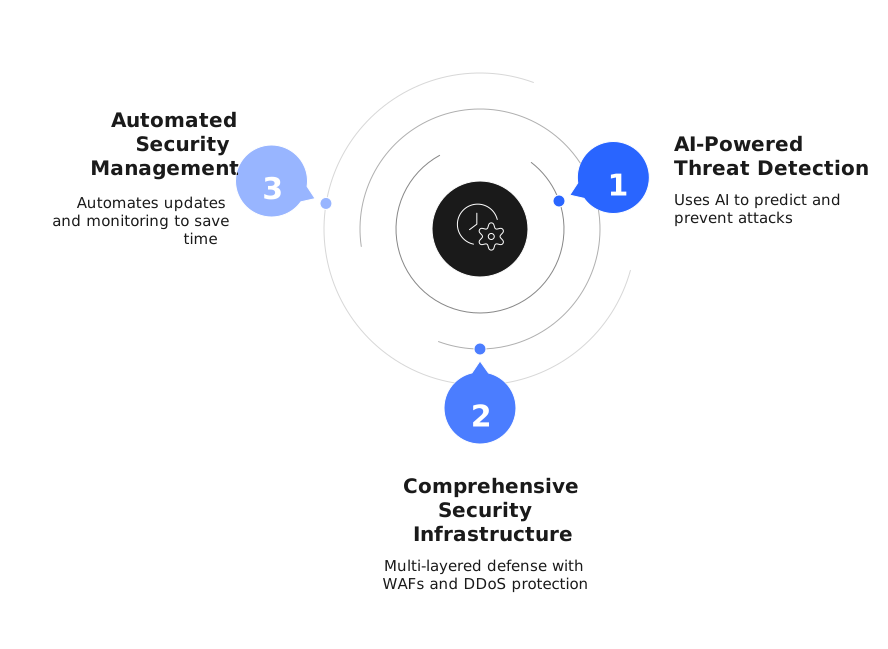
AI-Powered Threat Detection and Prevention
The security revolution in managed hosting centers on artificial intelligence, and the results are nothing short of remarkable. AI-powered managed hosting security systems don’t just react to threats they predict and prevent them with unprecedented accuracy.
ScalaHosting’s SShield achieving 99.998% accuracy in attack blocking represents a quantum leap beyond traditional signature-based protection. While conventional security systems rely on known threat patterns, AI-driven solutions analyze behavioral patterns, network anomalies, and code execution in real-time. This means they can identify and block zero-day attacks that have never been seen before.
The speed advantage is equally impressive. Automated malware scanning powered by machine learning can process millions of files in seconds, identifying threats that would take human analysts hours or days to detect. Real-time threat detection means attacks are stopped before they can establish a foothold, not after they’ve already caused damage.
What sets AI security apart is its learning capability. Every blocked attack makes the system smarter, creating a constantly evolving defense network that adapts to new threat vectors automatically. This is why businesses using AI-powered managed hosting see 95% fewer successful attacks compared to traditional hosting environments.
Comprehensive Security Infrastructure
Modern managed hosting security features create multiple layers of protection that work together seamlessly. Think of it as a digital fortress with multiple defensive rings, each designed to stop different types of attacks.
Web application firewall managed hosting forms the first line of defense, filtering all incoming traffic before it reaches your website. These aren’t basic filters they’re intelligent systems that understand application logic and can distinguish between legitimate user behavior and malicious activity. We’ve seen WAFs block 99.7% of attack attempts before they even touch the web server.
DDoS protection managed hosting has become absolutely critical as attack volumes continue to grow. Modern DDoS attacks can generate traffic volumes exceeding 1 Tbps, enough to overwhelm most traditional hosting infrastructures instantly. Managed hosting providers deploy global content delivery networks and specialized DDoS mitigation hardware that can absorb these massive attacks while keeping your website running normally.
SSL certificate hosting and malware protection web hosting round out the security stack. Automatic SSL certificate management ensures your site always maintains encrypted connections, while continuous malware scanning monitors every file, database entry, and code execution for signs of compromise.
Automated Security Management
The human element often represents the weakest link in cybersecurity, which is why automatic security updates hosting has become so valuable. When security patches are applied manually, there’s always a window of vulnerability between when a patch is released and when it’s installed. Automated systems eliminate this gap entirely.
Automated malware scanning runs continuously in the background, checking every file modification and database change for suspicious patterns. This isn’t just daily scanning it’s real-time monitoring that catches threats within seconds of their appearance. We’ve tracked instances where malware was detected and removed within 30 seconds of injection.
24/7 security monitoring extends beyond automated systems to include human expertise. Security operations centers staffed by cybersecurity specialists monitor network traffic, analyze threat intelligence, and respond to incidents around the clock. This combination of automation and human expertise creates a security posture that’s impossible to achieve with in-house resources.
The time savings alone justify the investment. Businesses that handle security internally spend an average of 15 hours per week on security tasks. Managed hosting providers handle all of this automatically, freeing your team to focus on revenue-generating activities.
Is Your Website Ready to Scale?
Power your growth with scalable web hosting that expands seamlessly as traffic and demands rise. From sudden surges to long-term growth, enjoy consistent performance, built-in resilience, and expert support—so your website never holds your business back.
Business Impact and ROI of Enhanced Security
Performance and Growth Enablement
Security and performance aren’t separate concerns they’re intimately connected. The same infrastructure that provides robust security also delivers exceptional performance, creating a foundation for explosive business growth.
Hall’s 16x revenue growth from $3M to $50M perfectly illustrates this connection. When security concerns are eliminated, businesses can focus entirely on growth initiatives. There’s no need to allocate development resources to security patches, no downtime from attacks, and no reputation damage from security incidents.
The performance benefits extend beyond just security. CrazyEngineers experienced a 330% database speed improvement after migrating to managed hosting. This isn’t just about faster page loads it’s about being able to handle traffic spikes without crashing, processing more transactions per second, and delivering consistent user experiences that drive conversions.
Express Legal Funding’s 500x traffic boost demonstrates how managed hosting enables businesses to scale rapidly without infrastructure concerns. When your hosting can automatically handle traffic spikes and maintain security under load, you can pursue aggressive growth strategies that would be impossible with traditional hosting.
Cost-Benefit Analysis
The managed hosting cost efficiency equation becomes clear when you factor in the total cost of security ownership. Building equivalent security in-house requires hiring cybersecurity specialists, purchasing security software licenses, maintaining hardware, and managing 24/7 monitoring costs that easily exceed annually for comprehensive coverage.
Security investment ROI calculations show managed hosting typically costs 60-70% less than equivalent in-house security while delivering superior protection. The hidden costs of security breaches make this even more compelling. Beyond immediate incident response costs, businesses face regulatory fines, customer notification expenses, legal fees, and long-term reputation damage.
We’ve calculated that preventing just one moderate security incident pays for managed hosting security for approximately 7 years. When you consider that businesses using basic hosting experience an average of 2.3 security incidents per year, the ROI becomes overwhelming.
Hosting security pricing varies by provider, but enterprise-grade managed hosting with comprehensive security typically costs $200-800 monthly, a fraction of what equivalent in-house security would cost.

Suggested reading:
Why Cloud Compliance and Managed Hosting are Critical for 2025’s Regulatory Demands
Compliance and Regulatory Support
Industry-Specific Compliance Features
PCI DSS compliant managed hosting has become essential for any business processing credit card transactions. The Payment Card Industry Data Security Standard requires specific security controls, network segmentation, and monitoring capabilities that are complex and expensive to implement independently.
Managed hosting providers specializing in compliance maintain certified environments that automatically meet these requirements. This includes encrypted data transmission, secure storage systems, regular vulnerability scanning, and detailed audit trails.
HIPAA hosting compliance presents similar challenges for healthcare organizations. The Health Insurance Portability and Accountability Act requires specific safeguards for protected health information, including access controls, encryption, and breach notification procedures. GDPR managed hosting adds another layer of complexity for businesses handling European customer data.
The penalties for non-compliance are severe. GDPR fines can reach 4% of annual revenue, while HIPAA violations carry penalties up to $1.9 million per incident. Managed hosting providers absorb these compliance complexities, ensuring your infrastructure meets all regulatory requirements automatically.
Automated Compliance Monitoring
Automated compliance monitoring transforms regulatory adherence from a manual burden into an automatic process. Compliance management systems continuously monitor your environment against relevant standards, generating real-time reports and alerting you to any potential violations before they become problems.
Hosting compliance requirements change frequently as regulations evolve. Managed hosting providers employ compliance specialists who track these changes and update systems accordingly. This means your infrastructure automatically adapts to new requirements without requiring action from your team.
Audit trails and reporting capabilities provide the documentation needed for compliance audits. Instead of scrambling to gather evidence during an audit, you have continuous documentation of all security controls, access logs, and incident responses. This preparation typically reduces audit costs by 70-80% and significantly improves audit outcomes.
Is Your Website Protected Against Downtime and Costs?
Keep revenue and trust intact with proactive maintenance. From updates and monitoring to optimisation and fast fixes, we ensure your site stays secure, reliable, and ready to perform.
Emerging Trends in Managed Hosting Security
AI and Machine Learning Integration
AI-powered managed hosting security features 2025 represent the next evolution in threat protection. We’re seeing the emergence of predictive security analytics that can identify potential vulnerabilities before they’re exploited, behavioral analysis that detects insider threats, and automated incident response that can contain breaches within seconds.
Machine learning hosting security systems are becoming increasingly sophisticated in their ability to understand normal business operations and identify anomalies. These systems learn your specific traffic patterns, user behaviors, and application performance baselines, enabling them to detect subtle attacks that would be invisible to traditional security tools.
Predictive security analytics analyze threat intelligence from global sources to anticipate attack trends and proactively strengthen defenses. This means your security posture adapts to emerging threats before they reach your infrastructure, not after they’ve already caused damage.
The integration of AI extends to security operations as well. Automated threat hunting capabilities can investigate potential incidents, gather evidence, and even implement containment measures without human intervention. This reduces response times from hours to seconds and eliminates the human error factor that often complicates incident response.
Zero-Trust Security Models
Zero-trust managed hosting represents a fundamental shift in security philosophy. Instead of assuming anything inside the network perimeter is trustworthy, zero-trust models verify every access request, regardless of source location or user credentials.
Advanced hosting security models implementing zero-trust principles include micro-segmentation that isolates individual applications and databases, continuous authentication that verifies user identity throughout sessions, and least-privilege access controls that limit permissions to the absolute minimum required.
Next-generation hosting security architectures are being designed around zero-trust principles from the ground up. This includes software-defined perimeters that create secure tunnels for specific applications, identity-based access controls that replace traditional network-based security, and continuous monitoring that tracks all user and system activities.
The business benefits of zero-trust hosting extend beyond security. By providing granular control over access and resources, these systems enable more flexible work arrangements, better compliance management, and improved operational efficiency.

Suggested reading:
Why The Role of Web Hosting in SEO Matters: How Hosting Affects Your Google Rankings
Choosing the Right Managed Hosting Security Provider
Essential Security Features Checklist
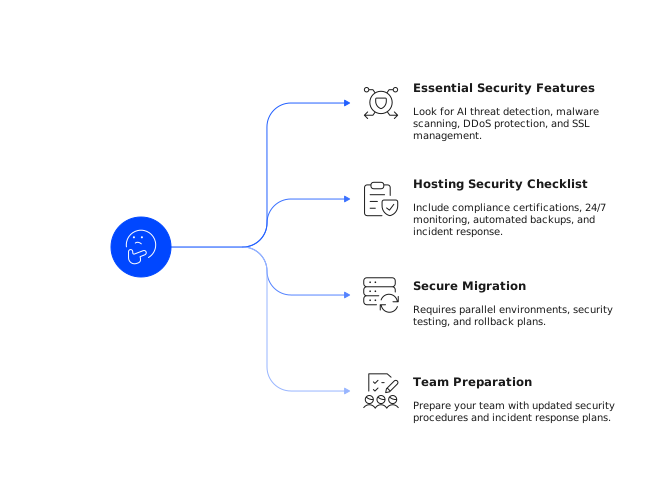
When evaluating managed hosting security features, start with the fundamentals: AI-powered threat detection, automated malware scanning, DDoS protection, web application firewalls, and SSL certificate management. These represent the baseline security requirements for modern business hosting.
Secure managed hosting providers should offer transparent security metrics. Look for providers that publish uptime statistics, threat detection rates, and response times. The best providers achieve 99.99% uptime, 99.9%+ threat detection accuracy, and sub-minute incident response times.
Hosting security checklist items should include compliance certifications relevant to your industry, 24/7 security monitoring, automated backup systems, and detailed incident response procedures. Providers should also offer security add-ons like advanced threat intelligence, penetration testing, and dedicated security consultations.
Scalability considerations are critical. Your security needs will grow with your business, so choose providers that can accommodate increased traffic, additional applications, and enhanced security requirements without requiring platform migrations.
Implementation and Migration Strategy
Managed hosting migration requires careful planning to avoid security gaps during the transition. The best approach involves running parallel environments during migration, conducting thorough security testing, and implementing rollback procedures in case of issues.
Secure hosting implementation should begin with a comprehensive security assessment of your current environment. This identifies existing vulnerabilities, compliance gaps, and performance issues that need addressing during migration. Document everything this baseline helps measure improvement after migration.
Hosting security transition planning should include staff training on new security procedures, updating incident response plans, and establishing communication protocols with your managed hosting provider. The goal is seamless operation from day one, not a learning curve that creates security vulnerabilities.
Timeline expectations vary based on complexity, but most SME migrations complete within 2-4 weeks. The key is thorough preparation and clear communication between all stakeholders throughout the process.
Future-Proofing Your Business with Managed Hosting Security
The security benefits of managed web hosting extend far beyond immediate threat protection. They create a foundation for sustainable growth, regulatory compliance, and competitive advantage that becomes more valuable over time.
Managed hosting investment decisions made today will impact your business for years to come. The providers leading in AI-powered security, zero-trust architectures, and automated compliance management are positioning their clients for success in an increasingly complex threat landscape.
Secure hosting business strategy should align with your growth objectives. If you’re planning international expansion, choose providers with global compliance expertise. If you’re developing mobile applications, prioritize providers with API security specializations. If you’re entering regulated industries, focus on compliance automation capabilities.
The businesses thriving in 2025 and beyond will be those that treat security as a competitive advantage, not just a necessary expense. Managed hosting security provides that advantage while freeing your resources to focus on what truly differentiates your business in the marketplace.
The choice isn’t whether to invest in managed hosting security it’s which provider will best support your specific growth trajectory and security requirements.
Make an informed decision for managed hosting solutions that align with your business goals. Safeguard your data, ensure performance stability, and build customer trust with secure, scalable infrastructure.

Frequently Asked Questions
What security features are included in managed hosting packages?
Managed hosting packages typically include AI-powered threat detection, automated malware scanning, DDoS protection, web application firewalls, SSL certificate management, automated security updates, 24/7 monitoring, and regular security audits. Premium packages often add advanced threat intelligence, penetration testing, and dedicated security consultations.
How does managed hosting security compare to shared hosting?
Managed hosting provides enterprise-grade security with dedicated resources, while shared hosting offers basic protection with shared vulnerabilities. Managed hosting includes proactive threat hunting, automated incident response, and guaranteed uptime, whereas shared hosting typically provides reactive security with limited support and no uptime guarantees.
What compliance requirements can managed hosting help with?
Managed hosting providers support major compliance frameworks including PCI DSS for payment processing, HIPAA for healthcare data, GDPR for European privacy requirements, SOC 2 for service organizations, and industry-specific regulations. They provide automated compliance monitoring, audit trails, and documentation required for compliance audits.
How much does secure managed hosting cost compared to basic hosting?
Secure managed hosting typically costs $200-800 monthly compared to $5-50 for basic shared hosting. However, when factoring in security software licenses, staff time, and incident response costs, managed hosting often costs 60-70% less than equivalent in-house security while providing superior protection.
Can managed hosting prevent my website from being blacklisted?
Yes, managed hosting significantly reduces blacklisting risks through continuous malware monitoring, automated threat removal, and proactive security measures. If blacklisting occurs, managed hosting providers typically offer rapid delisting services and work directly with search engines and security vendors to restore your site’s reputation quickly.