




Imagine your biggest sale day: traffic spikes, customers are ready to buy and your site suddenly crashes. Orders stop, revenue plummets, and shoppers move on. This happens far more often than it should, and the root cause is almost always the same: hosting that simply can’t scale.
Businesses lose thousands every month to downtime. Over half struggle with rising hosting costs, and nearly 50% face hacking attempts, with a third experiencing real breaches. These issues directly affect revenue, trust, and long-term growth.
In this guide, we’ll break down everything you need to know about scalable hosting for e-commerce growth, when to upgrade, how to avoid sudden cost spikes, and how to choose the right hosting model. We’ll also explore modern approaches like headless and composable commerce.
Why E-commerce Scalability Matters: The Hidden Costs of Inadequate Hosting
Hosting isn’t just a technical setup, it’s a core business system that directly affects revenue, customer experience, and security. Many e-commerce teams focus on marketing and product, while slow, insecure, or rigid hosting quietly sabotages growth through performance issues and unexpected cost spikes.
Scalability is about more than server size. It’s about infrastructure that grows with demand, protects revenue during peak periods, and maintains trust through strong security.
Here’s why it matters.
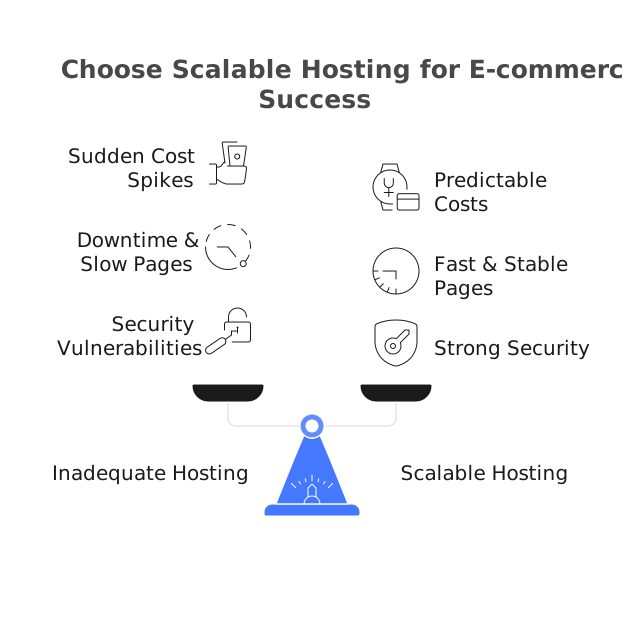
The Triple Threat: Cost Spikes, Downtime & Security Breaches
Growth-stage e-commerce brands consistently face three major hosting risks:
Sudden Cost Spikes
Hosting fees can jump 200–300% during rapid growth, catching businesses off guard and straining budgets.
Downtime & Slow Performance
Traffic surges often lead to slow pages and cart drop-offs. With 53% of users abandoning sites that load in more than 3 seconds, even minor delays translate to major revenue loss.
Security Vulnerabilities
Nearly half of businesses face hacking attempts, and one-third experience data breaches, leading to customer churn and long-term brand damage.
These issues compound each other: security incidents slow performance, traffic spikes inflate costs, and businesses spend hundreds monthly just trying to manage the chaos. With global e-commerce nearing $7T, the financial stakes are only rising.
What Scalable Hosting Actually Means for E-commerce Growth
Scalable hosting ensures your site can handle sudden traffic surges flash sales, viral campaigns, seasonal spikes, without slowing down or crashing. It keeps conversion rates stable when demand peaks and prevents revenue loss during your biggest sales moments.
There are two approaches:
- Vertical scaling: upgrading one server.
- Horizontal scaling: adding multiple servers to share the load.
For fast-growing e-commerce brands, horizontal cloud scaling is the better choice, it’s flexible, automated, and built for unpredictable traffic patterns.
Scalability also ties directly into modern e-commerce architecture. As more brands move toward composable and headless commerce, flexible cloud infrastructure becomes essential. Investing in scalable hosting now positions businesses for growth, stability, and future-proof innovation.

Suggested reading:
Managed Cloud Hosting Guide for SMEs: Essentials and Advantages To Know
Understanding Hosting Options: From Shared to Cloud Infrastructure
Choosing the right hosting becomes much easier once you understand how each option aligns with your growth stage. There’s no universal answer, but there are clear signals that help you decide when to stay put and when to upgrade. Below is a simplified breakdown of the main hosting types and when each one makes sense.

Shared Hosting: When It Works and When to Outgrow It
Shared hosting is a great starting point because it’s affordable and requires little technical setup. But since you’re sharing resources with many other sites, performance, security, and flexibility become major limitations as traffic grows.
You’ve likely outgrown shared hosting if you’re seeing:
- Traffic consistently above 5K monthly visitors
- Slowdowns during small spikes
- Increasing security risks
- The need for custom configurations
If any of these apply, it’s time to consider more scalable ecommerce web hosting options.
VPS, Dedicated, and Cloud: The Scalable Alternatives
Once shared hosting no longer fits, you’re choosing between VPS, dedicated servers, and cloud hosting:
VPS Hosting
A mid-level upgrade that gives you dedicated resources within a shared physical server. It’s affordable and customizable but still requires manual scaling.
Dedicated Servers
A full physical server for your brand alone. High performance and control, but expensive and slow to scale.
Cloud Hosting
The most flexible option for growing e-commerce brands. Resources scale automatically with traffic, pricing adjusts to usage, and uptime stays consistently high.
Managed Hosting: Turning Infrastructure Into an Advantage
Managing servers internally drains time, money, and focus. That’s why many e-commerce brands turn to managed hosting, where experts handle setup, security, optimization, scaling, backups, and round-the-clock monitoring.
Yes, it costs more upfront but it eliminates DevOps hiring, reduces downtime risk, and frees your team to focus on revenue-driving initiatives. With guaranteed uptime SLAs and proactive support, managed hosting becomes a growth lever, especially for teams without deep technical resources or those prioritizing speed and reliability.
Is Your Infrastructure Slowing Down Customer Experience?
Old hosting setups choke during traffic spikes and slow your e-commerce performance. We modernize and optimize your cloud environment for blazing speed, consistent uptime, and seamless scalability across every customer touchpoint.
The Cost Reality: Managing Hosting Expenses from $10K to $10M Revenue
Hosting costs are one of the biggest pain points for e-commerce brands 57% say hosting is too expensive, and resolving issues alone averages €345 EUR/month. The real problem isn’t the monthly bill itself, but the lack of cost planning as businesses scale. Hosting should grow proportionally with revenue, not spiral during peak periods or promotions.
Costs naturally rise with traffic, bandwidth, storage, and security needs, but they should remain 3-5% of revenue. If hosting hits 10–15%, the architecture or provider isn’t optimized.
Sudden 200-300% cost spikes usually occur when businesses grow faster than their infrastructure planning.
Preventing Cost Spikes During Rapid Growth
Run a big campaign → traffic surges → next month’s hosting bill explodes. This scenario is entirely avoidable with the right planning.
Here’s how to keep costs predictable:
- Use auto-scaling with spending caps
Grow capacity during spikes but prevent runaway cost increases. - Forecast traffic using historical data
Pre-plan capacity for events like Black Friday instead of paying emergency rates. - Optimize before scaling
Caching, database tuning, and CDNs can cut resource usage by up to 50%. - Negotiate long-term or reserved capacity
Commit to baseline resources and save 30-50% compared to on-demand pricing. - Apply FinOps practices
Real-time cost monitoring and alerts stop small issues from becoming five-figure bills.
With these strategies, brands consistently keep hosting costs in the 3-5% revenue range, even during periods of 10x traffic growth. The fastest-scaling e-commerce businesses don’t just react to growth; they architect for it.
Performance Optimization: Preventing Revenue Loss from Slow Load Times
Site speed isn’t a technical detail, it’s a direct revenue lever. Slow load times cause abandoned carts, wasted ad spend, and lost sales. Fast sites convert more, rank better, and outperform competitors during high-traffic periods.
The Revenue Impact of Every Second
Speed has a measurable ROI. 53% of users abandon pages that take over 3 seconds to load, and every 1-second improvement boosts conversions by 7%.
If your e-commerce store makes $1M a year and you shave just one second off load time, that’s roughly €60,000-€64,000 in additional annual revenue, purely from performance gains. During peak traffic, the impact is even bigger: at 2-second load times, 47% of carts are abandoned.
This is why performance should be prioritized alongside marketing. Faster sites earn more, especially during campaigns, product drops, and seasonal spikes.
CDN, Caching & Load Balancing: The Speed Trio
These three technologies deliver the biggest performance gains with the highest ROI:
- CDN (Content Delivery Network)
Delivers static content from servers closest to the user, drastically reducing latency. Essential for international customers and immediate global speed improvements. - Caching
Stores frequently accessed data in memory, cutting database load by 50–70%. Product pages load faster and servers stay stable during spikes. - Load Balancing
Distributes traffic across multiple servers so no single machine becomes a bottleneck. MVMT Watches saw a 30% conversion lift after switching to load-balanced hosting.
Together, these solutions keep your site fast, stable, and revenue-ready, even at 10x traffic. Modern server architectures now deliver up to 58% improvement in checkout capacity, proving how directly infrastructure influences profit.

Security and Compliance: Protecting Revenue and Customer Trust
Security breaches aren’t just technical headaches they’re revenue killers. Nearly half of businesses face hacking attempts, and a third suffer actual data breaches. The fallout goes far beyond the breach itself.
The Real Business Cost of Security Failures
Most people think breach costs stop at investigations, legal fees, and customer notifications.
In reality, those are just the surface.
Regulatory penalties are often the biggest hit.
GDPR fines can reach €20M or 4% of global revenue, and PCI DSS violations can jeopardize your ability to process card payments entirely.
Customer loss is even worse.
Around 60% of customers abandon brands after a breach, years of trust can evaporate overnight.
Downtime adds to the damage.
E-commerce stores lose an average of €5,000–€5,100 per minute when systems go offline.
SEO takes a hit too.
Malware flags can tank organic traffic by 40–60%, and regaining lost rankings can take months.
All of this compounds into long-term brand damage, competitors highlight their security, while your business navigates recovery. It’s why strong security measures aren’t “nice-to-have”; they’re foundational to protecting revenue.
Essential Security Features in E-commerce Hosting
Scalable hosting for e-commerce growth must include robust, built-in security.
At minimum, look for:
- SSL/TLS Encryption
Encrypts all data customers submit and boosts both trust and SEO. - Web Application Firewall (WAF)
Blocks common attacks like SQL injection and cross-site scripting before they hit your server. - DDoS Protection
Keeps your store online during traffic floods – intentional or accidental. - Automated Malware Scanning & Removal
Identifies threats early and removes them before they affect customers or search rankings. - Automated Backups & Point-in-Time Recovery
Fast restoration after errors, breaches, or system failures. Daily backups and 30-day retention are ideal. - Multi-Factor Authentication (MFA)
Prevents unauthorized access even if credentials are leaked.
Managed e-commerce hosting typically includes all of these out of the box, while self-managed setups require manual configuration and ongoing monitoring. When comparing cloud hosting companies, evaluate security as a core revenue protection layer, not an optional extra.
These layers work together as a “defense-in-depth” system: if one fails, others prevent the threat from escalating. That’s how you safeguard both customer trust and long-term growth.
Are You Losing Sales to Slow Load Times?
High-growth stores can’t rely on basic hosting. We engineer fast, resilient, and scalable e-commerce environments that support high traffic, heavy catalogs, global visitors, and API-driven architectures without breaking under pressure.
Modern Architecture for Future Growth: Composable and Headless Commerce
E-commerce is shifting toward composable and headless architectures, both powered by API-first systems that demand hosting built for speed, scalability, and distributed workloads.
Composable commerce replaces all-in-one platforms with modular, API-connected services for catalog, checkout, CMS, search, and personalization. This lets you swap or upgrade individual components without replatforming and adapt quickly as your business evolves.
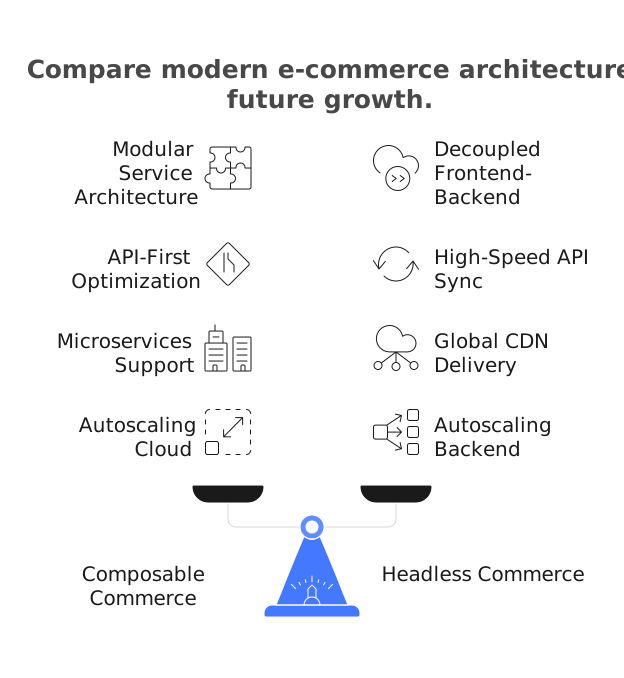
Because APIs handle constant communication between services, composable commerce requires:
- API-first architecture for high-volume requests
- Microservices support (Docker, Kubernetes)
- Reliable inter-service monitoring
- Cloud infrastructure that can autoscale and manage distributed systems
Cloud-based e-commerce environments are the natural fit, they offer managed API gateways, container orchestration, scaling, and observability out of the box.
Headless commerce also depends on high-performance APIs. It decouples your frontend from backend logic, allowing fast, channel-agnostic experiences across web, mobile, and emerging interfaces.
To run smoothly, headless setups need:
- High-speed APIs for continuous frontend–backend sync
- Global CDN delivery for ultra-fast storefronts
- Autoscaling backend services for multi-channel demand
- Strong caching to reduce API load
Real-world proof: MVMT Watches increased conversions by 30% using a headless architecture supported by a load-balanced, multi-server environment.
Bottom line:
Composable and headless commerce only reach their full potential when backed by scalable hosting optimized for API performance, global CDN reach, and distributed cloud environments. When evaluating providers, make API speed, reliability, and scalability your top criteria.

Suggested reading:
Boost Your Bottom Line: How Web Hosting Uptime Impacts Business Revenue and Customer Trust
Case Studies: Migration Wins That Delivered Real Revenue Impact
The strongest proof of effective migration is measurable business results. These real-world examples show what’s possible when performance, scalability, and architecture align.
DeBra’s migration to BigCommerce delivered a 215% revenue increase and 627% jump in customer engagement. Their previous infrastructure couldn’t support growth; scalable hosting unlocked their next stage.
MVMT Watches improved their hosting architecture with a load-balanced multi-server setup, resulting in a 30% conversion rate increase – a direct revenue lift without additional marketing spend.
PUMA’s global migration to Google Cloud resulted in a 19% increase in average order value and 4× faster real-time inventory access, proving that infrastructure improvements scale from SMBs to global brands.
What unites these outcomes?
- Thorough planning
- Staged, zero-downtime execution
- Deep performance testing
- A focus on business metrics – not just technical specs
They didn’t migrate for novelty; they migrated to increase speed, reliability, scalability, and revenue.
For any business, be it a startup, growth stage, or enterprise, the takeaway is the same: the right hosting partner with proven migration expertise protects business continuity while setting the foundation for long-term scalability.
Is Managing Your Hosting Taking Time Away from Growth?
Infrastructure shouldn’t be a daily burden. Our managed cloud services automate updates, monitoring, security, and scaling, giving you a fast, stable, self-optimizing foundation for e-commerce expansion.
Taking Control of Your E-commerce Growth
Scaling an e-commerce business requires more than adding products and marketing spend, it demands infrastructure that can keep up. The core challenges remain universal: rising hosting costs during traffic surges, performance slowdowns, and increasing security risks. Understanding these pain points is the first step toward building a store that can grow without breaking.
Key decisions will shape your long-term success: knowing when to move beyond shared hosting, choosing the right environment (VPS, dedicated, or cloud) for your stage of growth, and deciding whether a managed or self-managed setup aligns with your team’s capabilities. The right choice today prevents bottlenecks tomorrow.
Brands like DeBra, MVMT, and PUMA have already proven the impact, higher conversions, stronger reliability, and measurable revenue gains, all driven by scalable hosting that removes technical limits. As the industry shifts toward AI-powered scaling, edge computing, and composable commerce, having flexible infrastructure will be the difference between keeping up and getting left behind.
You now have the clarity to make informed hosting decisions that support growth instead of restricting it. The real question isn’t if you should upgrade, it’s when your business is ready to scale without compromise.
Create an infrastructure foundation that boosts speed, eliminates downtime, and supports predictable long-term growth. Stop reacting to hosting limitations.
Build the scalable environment your e-commerce business deserves.

Frequently Asked Questions
What is scalable hosting for e-commerce and why does it matter?
Scalable hosting automatically expands or reduces server resources based on traffic demand, ensuring your store stays fast and stable at all times. It matters because it prevents downtime during surges, keeps page load times consistently high-performing, and maintains a smooth shopping experience even as your audience grows.
How does scalable hosting support businesses at different growth stages?
Scalable hosting adapts to your store’s evolving needs, from early-stage brands with modest traffic to established businesses handling complex operations and high-volume visitors. As your e-commerce stack becomes more sophisticated, scalable infrastructure ensures you can add products, run campaigns, and handle peak demand without replatforming or hitting performance limits.
What's the difference between managed hosting and cloud hosting for e-commerce?
Managed hosting is a service model where the provider handles setup, monitoring, security, backups, and technical upkeep for you. Cloud hosting is an infrastructure model offering flexible, on-demand computing power. You can combine the two with managed cloud hosting, choose fully self-managed cloud environments, or opt for managed dedicated servers depending on your team’s expertise and operational needs.
How can I prevent downtime during traffic spikes like Black Friday?
Use auto-scaling environments that adapt instantly to higher demand, combined with load balancing to distribute traffic across multiple servers. Add a CDN and aggressive caching to reduce server strain, and perform load tests before major campaigns. Together, these steps ensure your store stays online and responsive, even during extreme surges.
When should I migrate from shared hosting to cloud infrastructure?
It’s time to upgrade when you’re seeing recurring slowdowns, unpredictable performance during moderate traffic increases, or handling enough transactions that security and reliability become top priorities. Businesses also migrate when they need more customization, integrations, or speed than shared hosting can provide, typically when growth momentum makes stronger infrastructure a necessity.


